Hexa Master 3D - Color Sort
- 4.6
- Rating
- 5.00M
- Installs
- Free
- Price
 Analysis by App-foxy
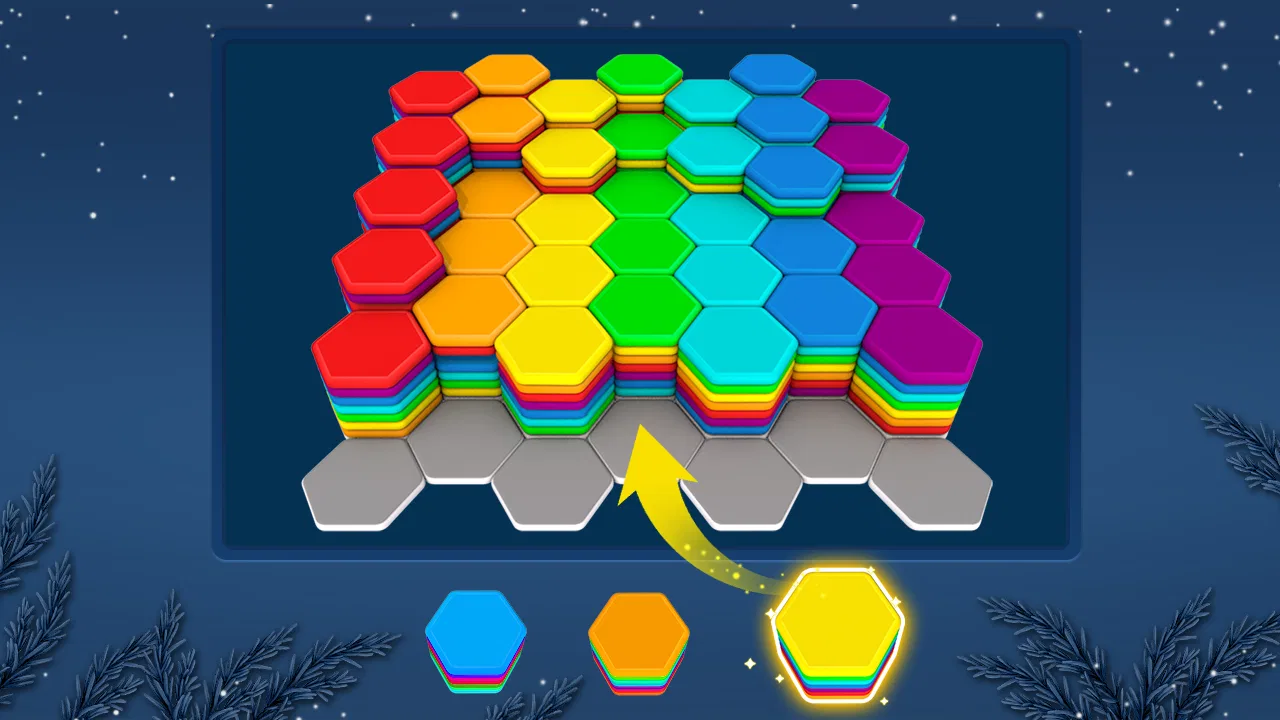
I picked up Hexa Master 3D - Color Sort expecting a quick color-matching distraction, and that is exactly where it works best. It is a casual puzzle game from Higgs Studio built around arranging colorful three-dimensional hexagonal pieces, with a simple goal that becomes more demanding as the board fills. I did not need a tutorial marathon or a long explanation before making the first move. The appeal is immediate: look at the available pieces, identify a useful color or shape relationship, and place it before the open spaces become awkward.
That quick start matters because this is not a game I would reserve for a long, uninterrupted evening. I see it as something to open while waiting for a coffee, taking a short break, or winding down when I want a little visual activity without committing to a story or complicated control scheme. The free download makes it easy to try, and the Everyone age rating fits the friendly, non-threatening presentation.
Why the first few moves feel so accessible
The central pleasure comes from turning a messy-looking arrangement into something orderly. Hexagonal tiles give the board a different visual rhythm from the square grids used by many familiar match and sorting games. The three-dimensional presentation also makes each move feel more tactile, even though the interaction remains straightforward. I found myself focusing less on speed and more on keeping future options open.
You May Also Like

 Google Keep - Notes and lists
Google Keep’s Quiet Growth Shows the Appeal of Simpler Notes
As mobile work gets busier, Google Keep keeps winning a simple contest: capture a thought quickly, find it later, and get on with the day.

 Blood Strike: 2.5 Anniversary
Blood Strike’s Loadouts Turn Every Drop Into a Tactical Gamble
A close look at Blood Strike’s custom loadouts: how fast access to signature weapons reshapes its battle royale rhythm, rewards preparation, and narrows the gap between fights.

 Pandora - Music & Podcasts
Pandora’s Music Is Easy to Start, but Harder to Recover
Pandora’s strength is its low-effort path from a seed to a station. Its weak spot is how much confidence it asks you to place in connection, setup, and quiet recovery.

 8 Ball Pool
 Is Built on Rivalries, Rematches, and Routine
A close look at the rivalries, rematches, shared routines, and unanswered safety questions that turn a quick pool match into a persistent mobile community.

 Samsung Music
’s Quiet Strength Is Playing What You Already Own
Its reach comes less from spectacle than from dependable access to a personal library. That simplicity is both the app’s strongest retention engine and its ceiling.

 AccuWeather: Weather Radar
AccuWeather Review: A Quick, Clear Forecast for Everyday Decisions
For everyday plans, the best forecast is the one you can understand quickly. AccuWeather makes rain timing, radar, and local conditions easy to act on, with a few trade-offs.
More From Our News Desk



The early play is especially welcoming because the rules are easy to understand through action. You can see the available colors, judge where a piece might fit, and learn from the result without studying a manual. That makes the game suitable for someone who enjoys puzzles but does not normally play mobile games. It also means the game can be handed to a friend or family member without needing a lengthy explanation.
Its store rating sits at 4.6 from roughly 35 thousand ratings, and the game has passed 5 million installs. Those figures do not replace personal testing, but they do match my impression that the basic loop is easy for a broad audience to understand. The game is not trying to overwhelm you with systems. Its strongest idea is the small satisfaction of making the board cleaner one decision at a time.
There is a useful distinction between recognizing a color and planning a placement. A move can look correct because it completes an obvious group, yet still leave the remaining pieces in an inconvenient pattern. I started treating empty spaces as resources rather than simply looking for the most visible match. That small change made the puzzles feel more thoughtful without making them inaccessible.
A rhythm that suits short breaks
The best sessions are the ones where I have only a few minutes. I can begin a level, make meaningful progress almost immediately, and stop when my attention is needed elsewhere. The game does not require me to remember a complicated storyline, maintain a team, or follow a long chain of objectives. When I return, the visual state of the puzzle is enough to remind me what I was trying to do.
This short-session quality is more important than it may sound. Many casual games are easy to start but create pressure to continue through timers, energy systems, or lengthy reward sequences. Here, the basic sorting activity remains the reason to play. I can enjoy a small burst of concentration without feeling that I have missed an important event by closing the app.
In an everyday situation, I would use it during a ten-minute wait before an appointment. I could play carefully for a while, put the phone away when my name is called, and return later without needing to reconstruct a complicated plan. That makes it a better fit for fragmented time than a narrative adventure or a competitive multiplayer game.
The controls are also appropriate for one-handed use. I can concentrate on the board rather than on precise movement combinations. That said, the three-dimensional view means that visual clarity matters. On a smaller screen, crowded colors or overlapping pieces can take a moment longer to read. I found that slowing down slightly was more useful than trying to play quickly.
What happens when a puzzle becomes less obvious
The game’s simplicity does not mean every decision is automatic. Once the board offers several similar choices, the challenge shifts toward sequencing. I often had to decide whether to use a convenient placement now or preserve that space for a piece that would otherwise be harder to handle. This is where the sorting theme earns its place: the puzzle rewards organization, not just reflexes.
One practical tip is to scan the entire board before touching the most attractive move. The obvious match is not always the safest one. I had better results when I first identified blocked or awkward areas, then worked backward to protect the spaces needed to reach them. This is a small habit, but it reduces the number of situations where the board feels suddenly impossible.
A second useful approach is to avoid filling a central area too early when the surrounding pieces still need room. In a compact hexagonal layout, one placement can affect several neighboring possibilities. Leaving a flexible gap may feel inefficient for a few seconds, but it gives more freedom later. I would not call this an advanced strategy in the traditional sense, yet it is the difference between casually tapping and actually reading the board.
I also noticed that the three-dimensional styling can make a move appear more important than it is. A raised or visually prominent tile naturally attracts attention, but the quiet option may be strategically better. When I stopped following the most noticeable piece and instead considered the next two placements, the game became calmer and more rewarding.
Returning after an interruption
For me, interruption tolerance is one of the most valuable qualities in a casual mobile game. Hexa Master 3D - Color Sort works well in that role because its state is visual and local. I do not need to recall a plot, a conversation, or a set of temporary instructions. I simply look at the board and start evaluating the available choices again.
This makes it suitable for the stop-and-start pattern of real phone use. A message, a train arrival, or a short conversation can interrupt a session, and the game still feels approachable when I come back. I prefer this to games that punish me for leaving at the wrong moment or make me spend the first minute reorienting myself.
The best way to return after a break is to resist making the first move immediately. I take a brief visual inventory: which colors are most constrained, which spaces are still open, and whether a previous plan remains sensible. That pause is useful because a board can look different after a few minutes away, even when nothing has changed. It helps me play deliberately rather than tapping out of habit.
This also answers an important question for anyone considering it as a relaxing game: it is more comfortable for casual attention than for constant focus. I can play carefully, but I do not feel that every second must be optimized. If you want a game that rewards fast reactions, this may feel too gentle. If you want something you can pick up and put down without losing the thread, its structure is much more appealing.
The game is free to download, although in-app purchases range from $1.99 to $99.99 per item. That is worth keeping in mind before handing the phone to a child or letting someone play without supervision. The Everyone rating describes the general audience, but it does not remove the need to pay attention to purchase settings. For my own use, I would treat the free version as the starting point and decide later whether any optional spending adds enough value.
Where the long-term appeal starts to weaken
The same focused simplicity that makes the game easy to return to can also limit its staying power. The core activity remains color sorting and arranging. If you enjoy repeating a familiar puzzle loop while gradually improving your decisions, that consistency is a strength. If you need constant mechanical variety, a deep campaign, or a strong social layer, you may begin looking elsewhere sooner.
I found the replay value depends heavily on my mood. When I wanted a quiet mental reset, repeating the basic pattern was comfortable. When I wanted surprise, the familiar structure felt less exciting. This is not a flaw that can be fixed by better concentration; it is a genuine trade-off in the design. The game offers a dependable type of pleasure rather than a constantly changing one.
Compared with a traditional match-three game, this feels less focused on rapid chain reactions and more on spatial planning. Compared with a classic sorting game, the hexagonal three-dimensional presentation gives it a more polished visual identity and makes adjacency easier to think about in layers. Compared with a large puzzle collection, it is narrower but less distracting. I would choose it when I want one clear activity, not a menu of unrelated challenges.
It is also not the right choice for someone seeking a story-driven experience. There are no character relationships or narrative reasons for continuing in the way an adventure game provides. Likewise, players who prefer competitive leaderboards or real-time opponents may find the solitary sorting loop too private. Its audience is the person who enjoys making a board behave and does not need external drama to stay engaged.
The current version is 2.5.6, and it runs on Android 7.0 or later. That makes it accessible to people using older compatible devices, though the visual presentation will still be easiest to appreciate on a screen with comfortable brightness and enough space to distinguish nearby colors. I would check that the device is supported before planning to use it on an older phone, especially if the display makes similar shades difficult to separate.
Small habits that make the game more enjoyable
My most effective habit is to separate “safe” moves from “necessary” moves. A safe move improves the board without closing an important route. A necessary move addresses a piece or color that may become difficult to place later. When I give necessary moves priority, I make fewer decisions that look good immediately but cause trouble several turns afterward.
Another useful habit is to use the edges as reference points. Rather than viewing the board as one large collection of colors, I divide it into manageable zones and ask which area is becoming crowded. This reduces visual overload and makes it easier to spot a placement that opens two possibilities at once. It is especially helpful when several pieces share similar tones.
I also recommend treating a failed attempt as information instead of rushing to restart. The board can reveal which type of placement created the bottleneck. If I remember that pattern, the next attempt becomes more deliberate. This turns repetition into practice, which is important because the game’s replay value comes more from improving judgment than from discovering an entirely new set of mechanics.
For a relaxed session, I would avoid playing while multitasking heavily. The game is forgiving in its pace, but it still benefits from a little visual attention. If I am constantly switching between the puzzle and another demanding task, I stop noticing the relationships between spaces and colors. It works best as a small break with one clear focus, not as background noise during a busy activity.
My casual verdict
After spending time with it, I see Hexa Master 3D - Color Sort as a dependable short-session puzzle rather than a game designed to dominate my free time. Its strongest qualities are the immediate rules, the satisfying cleanup of the board, and the ability to pause mentally when real life interrupts. Higgs Studio has kept the central idea approachable while giving it a distinctive hexagonal, three-dimensional look.
I would recommend it to anyone who likes sorting, color organization, and gentle spatial decisions. It is particularly good for waiting rooms, short commutes, quiet evenings, and those moments when I want something more engaging than scrolling but less demanding than a full game. The free entry point makes trying it simple, while the purchase range means I would still keep an eye on spending controls.
I would skip it if my priority were a rich storyline, competitive play, dramatic progression, or endless mechanical novelty. The repetition is part of the comfort, but it is also the main limitation. Players who quickly tire of sorting puzzles may appreciate the presentation at first and then feel that the underlying activity does not change enough.
For me, the deciding question is not whether it has the deepest puzzle system on mobile. It does not need to. The better question is whether I want a clean, readable activity that gives me a small sense of order in a short amount of time. When the answer is yes, Hexa Master 3D - Color Sort is an easy recommendation. Its best moments come from one careful placement, one newly opened route, and the quiet satisfaction of leaving the board in better shape than I found it.
My final recommendation: try it if you value immediate pleasure, easy pauses, and replayable color-sorting puzzles; choose a more varied puzzle collection or a story-based game if you need broader content to stay interested.
FAQs for Hexa Master 3D - Color Sort
01What is Hexa Master 3D - Color Sort about?
Hexa Master 3D - Color Sort is a puzzle game that challenges players to sort colored hexagons into their respective groups. The game offers varying levels of complexity as players progress, enhancing both strategic thinking and pattern recognition. It's designed for both casual and hardcore puzzle enthusiasts.
02Is Hexa Master 3D - Color Sort free to play?
Yes, Hexa Master 3D - Color Sort is free to download and play. However, it may include in-app purchases for additional features or to remove ads. These purchases are optional and the game can be enjoyed fully without spending any money.
03What platforms is Hexa Master 3D - Color Sort available on?
Hexa Master 3D - Color Sort is available on both Android and iOS platforms. Users can download it from the Google Play Store for Android devices or the Apple App Store for iOS devices, ensuring a wide accessibility for players using different mobile systems.
04Does Hexa Master 3D - Color Sort require an internet connection?
No, Hexa Master 3D - Color Sort does not require an internet connection to play. This makes it convenient for users who want to enjoy the game on the go or in areas with limited connectivity. However, some features, such as in-app purchases, may require internet access.
05Are there any age restrictions for playing Hexa Master 3D - Color Sort?
Hexa Master 3D - Color Sort is suitable for players of all ages. The game is designed with family-friendly content, making it accessible and enjoyable for both children and adults. However, parental guidance is advised for younger players due to optional in-app purchases.
Pros
- Engaging 3D graphics enhance gameplay.
- Intuitive controls for easy navigation.
- Challenging puzzles with increasing difficulty.
- Offline mode available for uninterrupted play.
- Regular updates with new levels and features.
Cons
- In-app ads can be disruptive.
- Limited free hints available.
- Some levels feel repetitive.
- No multiplayer or social features.
- Requires occasional internet for updates.

Hexa Master 3D - Color Sort
Gallery